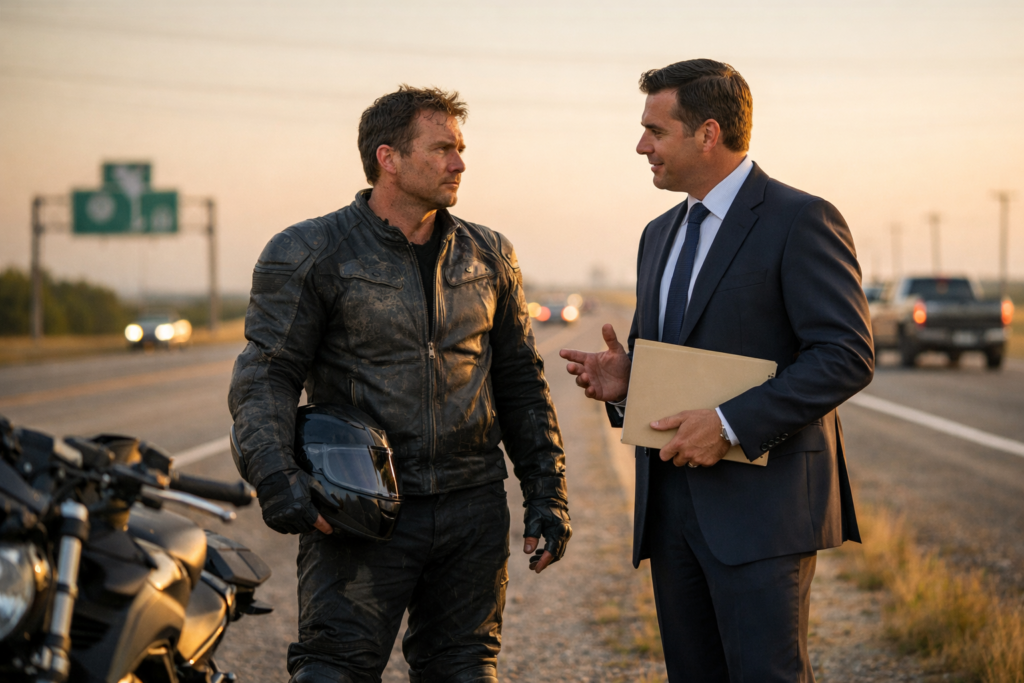
Texas' open-road culture, with its wide highways, high speed limits, and strong motorcycle presence, creates both freedom and crash risks to road users. The environment often leads to serious motorcycle accidents caused by speeding, distracted drivers, or reckless behavior.
Victims of these crashes can suffer life-altering injuries and endure substantial emotional and financial toll. You may be entitled to compensation if injured in a motorcycle crash caused by someone else's negligence.
However, obtaining a fair settlement value for your claim is not straightforward due to potential jury bias rooted in cultural perceptions of motorcyclists as risk-takers.
At Lorenz & Lorenz, our experienced motorcycle accident attorneys understand the legal and cultural dynamics at play. We advocate aggressively for injured riders, gather compelling evidence, and develop strategies to counter bias to protect your right to fair compensation.
Motorcycle Accidents Key Takeaways
- Texas' open-road culture can create jury bias, with some jurors unfairly assuming motorcyclists are reckless and partly at fault.
- Motorcycle accident attorneys counter bias through jury selection, expert testimony, and presenting compelling evidence of defendant negligence.
- Many motorcycle accidents are caused by other drivers, hazardous roads, or defective vehicles, not the rider, establishing liability for compensation.
- The value of compensation depends on injury severity, evidence strength, shared liability, recovery duration, and effective legal representation.
- Call a motorcycle accident attorney to counter jury bias.
How Texas’ Open-Road Culture Influences Motorcycle Jury Bias
Texas embraces a distinct open-road culture where freedom, independence, and personal transportation rights are deeply valued. This cultural backdrop influences how juries perceive motorcycle accident cases, often in ways that impact case outcomes.
Many Texans view motorcycling as an expression of personal liberty rather than reckless behavior. Jurors who appreciate this perspective may be more sympathetic to injured riders, recognizing their right to share the road.
However, the same culture can cut both ways. Some jurors may hold biases that lead them to assume motorcyclists inherently assume risks by choosing two wheels over four, potentially diminishing sympathy for injured riders.
The state's emphasis on personal responsibility also shapes jury attitudes. Jurors may scrutinize whether the motorcyclist wore proper safety gear, followed traffic laws, and rode defensively. They might apply higher standards of self-protection to riders than to other motorists.
Additionally, Texas' sprawling highways and rural roads create familiarity with motorcycle culture across diverse demographics. Jurors from areas where motorcycles are a common mode of transportation may view riders as ordinary commuters deserving equal protection.
Conversely, those less exposed to motorcycles might harbor unfounded assumptions about rider behavior.
How a Motorcycle Accident Attorney Can Counter the Bias in Court
Overcoming jury bias in motorcycle accident cases requires strategic legal approaches that reframe perceptions and emphasize facts over assumptions. A motorcycle accident lawyer can employ several proven methods to counter prejudice and secure fair compensation for injured riders.
Here are the strategies to counter the bias in court:
Jury Selection and Voir Dire
A motorcycle accident lawyer can screen potential jurors during voir dire to identify and address biases early. They ask targeted questions about attitudes toward motorcyclists, prior experiences with motorcycles, and preconceived notions about rider safety.
Their input in the selection helps eliminate jurors with deeply ingrained prejudices while educating others about the importance of impartiality.
Humanizing the Plaintiff
A motorcycle accident attorney can present motorcyclists as responsible individuals rather than stereotypical risk-takers. They highlight the rider's safety record, proper licensing, use of protective gear, and adherence to traffic laws.
They can use personal testimony to demonstrate why the client rides, whether for fuel efficiency, enjoyment, or practical transportation. They can help jurors see the plaintiff as a relatable person deserving equal road rights.
Emphasizing Defendant Negligence
Effective attorneys shift focus from the motorcycle to the defendant's actions. They can present compelling evidence showing how the other driver's carelessness, such as distracted driving, failure to check blind spots, or traffic violations, directly caused the collision.
Using Expert Witnesses
They can work with accident reconstruction specialists and motorcycle safety experts to provide an objective analysis of the crash. Their testimony can demonstrate that the accident resulted from the defendant's negligence, rather than from inherent dangers associated with riding a motorcycle, countering the assumption that riding itself was reckless.
Addressing the Bias
A motorcycle accident lawyer can acknowledge potential bias openly. They remind jurors of their duty to judge based on evidence and law, not personal feelings about motorcycles. They can use the direct approach to neutralize prejudice by bringing it into conscious awareness.
Visual Evidence and Technology
A motorcycle accident lawyer can utilize dashcam footage, surveillance videos, and computer simulations to provide undeniable visual proof of what occurred. The visual evidence overrides subjective biases by showing exactly how the defendant caused the accident.
Are Most Motorcycle Accidents the Bikers’ Fault?
A common misconception in motorcycle accident cases is that the rider is usually at fault. In reality, many crashes result from the negligence of other drivers, hazardous road conditions, or vehicle defects.
Determining fault in these cases can help your claim, given cultural biases that paint motorcyclists as reckless or careless. This perception can affect insurance claims and jury decisions.
A motorcycle accident attorney can help you prove fault in the collision. They can gather, present compelling evidence, and show that the rider was not responsible. A motorcycle accident attorney can use the following types of evidence to prove fault:
Police Reports
Police reports provide an official account of the accident and often include details that help establish fault. A lawyer can use these reports to support the motorcyclist's claim by analyzing:
- Citations issued to drivers for traffic violations
- Officer statements on the accident cause
- Diagrams of vehicle positions at impact
- Witness statements collected at the scene
- Observations about environmental or road conditions
Photographic and Video Evidence
Photos and videos from the accident scene, nearby traffic cameras, or dashcams can reveal details such as vehicle positions, skid marks, or road hazards. A motorcycle accident lawyer can use visual evidence to reconstruct the accident and demonstrate how another driver's actions caused the crash.
Witness Testimony
Eyewitnesses, including other drivers, pedestrians, or bystanders, can provide objective accounts of the accident. A motorcycle accident lawyer can interview witnesses to collect statements that confirm the rider's safe behavior and the other party's negligence.
Accident Reconstruction Experts
A motorcycle accident attorney can collaborate with experts in accident reconstruction to analyze vehicle speed, impact angles, and collision dynamics. They can produce reports or testify in court showing how the accident occurred and prove that the motorcyclist was not at fault.
Vehicle Inspection and Mechanical Reports
Mechanical failures can also contribute to accidents. A motorcycle accident attorney can obtain inspection reports to determine if a vehicle defect, such as faulty brakes or tires, caused the crash, shifting liability away from the rider.
Medical Records
Medical records include details that link injuries to the accident and demonstrate fault. A motorcycle accident attorney can use these records to show how the crash occurred and how the injuries reflect impact patterns caused by another driver.
A motorcycle accident attorney can support your compensation claim using:
- Emergency room reports
- Hospital admission and discharge summaries
- Imaging scans such as X-rays, CT, or MRI
- Surgical reports
- Rehabilitation and therapy notes
- Expert medical testimony on injury causation
Traffic Citations and Driving Histories
Citations issued to other drivers for speeding, running red lights, or other violations can demonstrate negligence. A motorcycle accident attorney can compile driving histories to establish a pattern of risky behavior contributing to the crash.
Environmental and Road Conditions
Unsafe road conditions, poor lighting, potholes, or debris also contribute to motorcycle crashes. A motorcycle accident lawyer can document these hazards using photographs or municipal records. They can use the evidence to demonstrate that road conditions, rather than the rider, contributed to the collision.
Who Is Liable in an Accident
Determining liability in motorcycle crashes involves identifying all parties whose negligence contributed to the collision. In Texas, where open-road culture influences jury perspectives, identifying potential defendants can help you build a compelling compensation claim.
Here are the parties who may be liable for the crash:
Other Motorists
The most common liable party is another driver who failed to exercise reasonable care. This includes drivers who fail to check their blind spots, make unsafe lane changes, run red lights, or drive distracted.
Texas juries sympathetic to open-road freedom often respond well when attorneys demonstrate how another motorist violated the motorcyclist's right to safely share the road.
Commercial Vehicle Operators and Employers
Truck drivers and their employers may be held liable when commercial vehicles cause motorcycle accidents. Companies can be held responsible for inadequate driver training, failure to maintain vehicles, or pressuring drivers to meet unrealistic schedules.
Establishing corporate negligence helps counter any jury bias by presenting a powerful defendant whose actions put a vulnerable rider at risk.
Government Entities
Municipalities and state agencies responsible for road maintenance may be liable when dangerous conditions contribute to crashes. Poorly maintained surfaces, missing signage, inadequate lighting, or hazardous road design can cause motorcyclists to lose control.
A motorcycle accident lawyer can demonstrate governmental failures to reinforce that external factors, not the choice to ride, caused the accident.
Vehicle Manufacturers
Defective motorcycle parts or design flaws may create liability for the manufacturer. Faulty brakes, defective tires, or mechanical failures can lead to accidents. Similarly, other vehicles with design defects that make motorcycles less visible contribute to crashes.
Property Owners
In some cases, property owners whose negligence creates roadway hazards may share liability. Debris, inadequate drainage causing standing water, or vegetation blocking sightlines can all contribute to motorcycle accidents.
How Much Compensation Can be Claimed for Motorcycle Accident?
There is no standard compensation you can receive for your injuries in a motorcycle accident. The amount of compensation a victim can receive from a motorcycle accident depends on the facts and circumstances of the crash.
Here are the factors that can influence the value of your claim:
- Severity of Injuries: The severity of your injuries can determine how much you can receive for your losses. The more serious the injuries, the higher the potential compensation.
- Availability of Evidence: Clear evidence, such as medical records, accident reports, and witness statements, strengthens the claim, leading to higher settlement or jury awards.
- Shared Liability: If insurers or opposing parties argue that the motorcyclist contributed to the accident, your compensation can be reduced to the extent of your liability.
- Duration of Recovery Period: A long-term injury often results in extended hospitalizations or rehabilitation, which can lead to a higher settlement value.
- Legal Representation: An experienced motorcycle accident attorney can enhance the value of your claim by gathering compelling evidence, negotiating assertively with insurers, and presenting a persuasive case in court.
Protect Your Rights After a Motorcycle Crash
Jury bias can undermine your recovery efforts by casting motorcyclists as reckless, even when the crash was caused by another driver. For example, a rider injured in a negligent driver's high-speed collision may face reduced compensation if jurors assume the rider was partially at fault.
At Lorenz & Lorenz, our motorcycle accident attorneys have decades of experience representing injured victims. You can count on us to counter these misconceptions and fight for your right to fair compensation.
Contact us for a free case evaluation.
Motorcycle Accidents Frequently Asked Questions
How Long Does a Motorcycle Accident Lawsuit Take?
Motorcycle accident lawsuit timelines vary based on injury severity, case complexity, and settlement negotiations. Simple cases with clear liability may resolve in months, while disputes requiring extensive evidence gathering, expert testimony, or trial proceedings can extend beyond a year or longer.
Should I Hire an Accident Attorney?
Yes, hiring an accident attorney is highly recommended. They understand how to counter jury bias in motorcycle cases, solve liability issues, and negotiate effectively. They can also help you make informed decisions that maximize your compensation and protect your rights.
How Much Does an Injury Lawyer Charge?
Most injury lawyers work on contingency, meaning they only collect a percentage of your payment if you win. Their fee comes from your settlement or award, so you pay nothing up front and risk nothing to pursue justice.