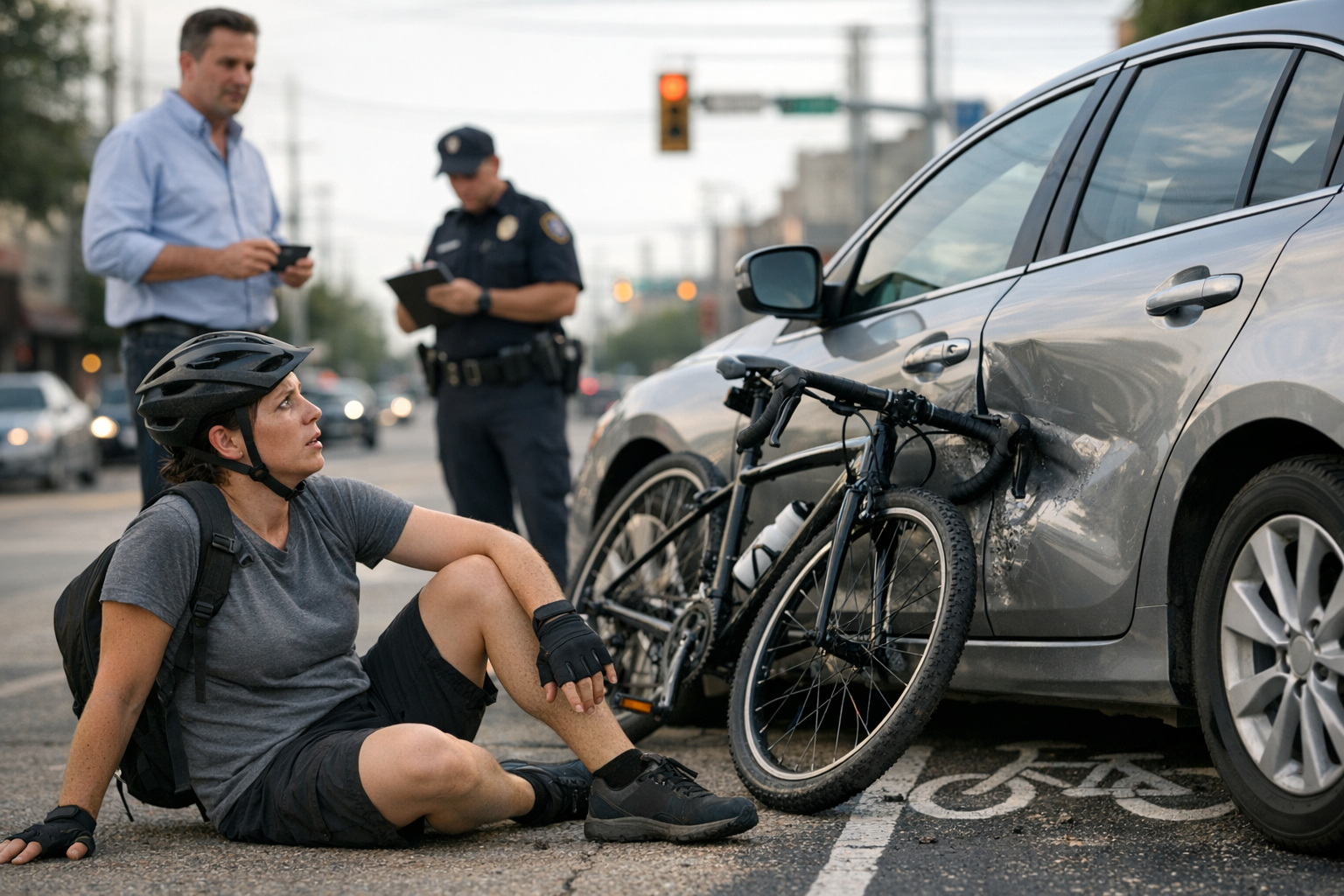
When a bicycle hits a car, many people assume the cyclist must be at fault. However, in reality, drivers are responsible for a significant number of these crashes. Even when the bicycle strikes the vehicle, the underlying cause often traces back to the driver’s actions, where they become fully or partially responsible. It is because drivers have a heightened duty of care to operate safely and be aware of all road users, including cyclists.
Determining fault relies on the specific actions of both parties in the moments leading up to impact. As you read on, you’ll learn how responsibility is determined, why drivers are often to blame, and how a lawyer can uncover the truth behind the collision. If you’ve been involved in such an incident, the personal injury team at Lorenz & Lorenz, PLLC can help you understand your rights. Reach out to us for a free consultation.
Key Takeaways: Who Is at Fault if a Bicycle Hits a Car
- Drivers are often at fault in bicycle-car collisions, even if the bike strikes the car.
- Common driver mistakes include right-hook turns, distracted driving, speeding, drifting into bike lanes, and failing to yield.
- Proving fault requires strong evidence, such as police reports, photos, witness statements, and accident reconstruction.
- Cyclists can recover damages for medical expenses, lost income, pain and suffering, property damage, and other losses.
- Helmet use, lane splitting, or riding an e-bike does not automatically remove driver liability.
- Multiple parties, including employers or delivery companies, can be held responsible under specific conditions.
- Consult a bicycle accident attorney quickly to preserve evidence, protect your rights, and help maximize compensation.
How to Prove Responsibility in a Bicycle Accident
Proving fault in a bicycle accident requires establishing that the driver’s actions caused the crash. Even when a bicycle hits a car, the driver may still be responsible if they created the dangerous situation that left the cyclist with no safe way to avoid the collision. Building a strong claim involves gathering clear evidence that shows how the driver failed to follow traffic laws or use reasonable care on the road.
Establish the Driver’s Legal Duty and Breach
Texas law requires drivers to drive with ordinary care. It means the care a reasonably prudent person would use under the same circumstances. For cyclists, this duty is heightened. For example, drivers must:
- Actively look for and anticipate cyclists, especially at intersections, in bike lanes, and when making turns.
- Cede right-of-way to cyclists when required by law, such as when riding straight through an intersection and a driver is turning right.
- Pass cyclists at a safe, legal distance of a minimum of three feet of clearance where feasible.
- Refrain from any activity that diverts attention from the road.
Proof of fault begins by showing how the driver failed in one of these specific duties. For example, witness testimony or phone records showing the driver was texting establishes a breach of the duty to avoid distractions.
Gather and Analyze Critical Evidence
Clear, concrete evidence is essential to address conflicting accounts. Key pieces to use include:
- Police Report: While not definitive, the responding officer’s initial assessment, diagrams, and any citations issued are influential.
- Photographic & Video Evidence: Photos of the final resting positions, vehicle damage, bike damage, skid marks, road conditions, and visibility sightlines. Dashcam, bike cam, or surveillance footage is invaluable.
- Witness Statements: Independent accounts from bystanders, passengers, or other drivers can corroborate the sequence of events and the driver’s behavior.
- Expert Reconstruction: An accident reconstruction expert can analyze the physical evidence to determine speeds, angles, and positioning, often proving the driver had the last clear chance to avoid the crash.
Showing Causation and Damages
To successfully determine fault in bicycle collisions, you must directly link the driver’s breach of duty to the accident and your resulting harm. It includes proving the following.
- Causation: Evidence must show that the driver’s specific action directly caused the cyclist to strike the vehicle to avoid a worse collision. The concept of “last clear chance” or that the driver had the final chance to avoid the accident is often central.
- Damages: Comprehensive documentation of your injuries, medical treatment, lost income, bike repair costs, and pain and suffering is essential. It proves the tangible impact of the driver’s fault.
With robust evidence demonstrating causation and damages, the value of your claim improves significantly. An accident reconstruction expert report can definitively establish vehicle speed, angle of impact, and which party encroached into the other’s path. Also, initial medical reports created hours after the crash and continuous medical reports are powerful proof that the injuries were acute and directly caused by the traumatic event.
When Are Drivers to Blame?
Drivers can be at fault in many bicycle–car collisions, even when the point of impact suggests the cyclist hit the car. In most cases, crashes happen when the driver creates an unsafe situation that the cyclist can not avoid. Here are the most common scenarios where drivers bear responsibility:
The Right-Hook Turn
This is a leading cause of serious bicycle-car collisions. It occurs when a driver passes a cyclist traveling in the same direction and then makes an immediate right turn directly across the cyclist’s path. The cyclist, proceeding straight, hits the side of the turning vehicle.
The driver failed to yield the right-of-way, violated the cyclist’s right to the lane, and made an unsafe turn without ensuring the lane was clear. The driver enjoyed the “last clear chance” to avoid the accident by checking mirrors and blind spots before initiating the turn.
When Drivers Are Distracted or Using Their Phones
Distracted driving is a leading contributor to bike-car collisions in Texas. Drivers using their phones, adjusting controls, eating, or interacting with passengers often miss cyclists entirely until the moment of impact. In these cases, the cyclist is reacting to a driver who wasn’t paying attention, making the driver legally responsible for the crash
The Left-Cross Turn
This happens when a driver turning left at an intersection or driveway fails to yield to an oncoming cyclist who is proceeding straight through the intersection with the right-of-way. The cyclist hits the side or front of the turning car.
Texas law demands that a driver turning left must yield to all oncoming traffic, which includes bicycles. The driver is responsible for accurately judging the speed and distance of the cyclist before completing the turn. Impatience .or misjudgment is not a defense
The Dooring Incident
These cases happen when the driver or passenger opens the door without regard to the oncoming cyclist. The cyclist has no time to stop and strikes the door or swerves to avoid it, potentially crashing into adjacent traffic.
Texas law requires a person to ensure it is safe to open a vehicle door and not open it if it will interfere with traffic. The driver is responsible for checking for cyclists in the bike lane or roadway before exiting. If they fail, this is a clear breach of the duty of care.
When Drivers Drift Into Bike Lanes
Bike lanes are legally reserved spaces meant to protect cyclists from vehicle traffic. When a driver drifts, merges, or parks in a bike lane, they instantly create a dangerous obstruction. Cyclists often have no choice but to brake abruptly or collide with the vehicle, making the driver responsible for entering a protected area they were required to avoid.
When Drivers Fail to Adjust to Low-Visibility Conditions
Drivers must reduce speed and increase caution during fog, rain, nighttime riding, or bright sun glare. When a driver claims they didn’t see the cyclist, it means they were not driving appropriately for visibility conditions. If a cyclist impacts the vehicle in these situations, the driver may still be at fault because visibility is the driver’s responsibility.
When Drivers Speed in Unfavorable Conditions
Speeding reduces a driver’s reaction time and significantly increases stopping distance, which puts cyclists at particular risk. On residential streets, near schools, or in pedestrian-heavy areas, drivers traveling too fast often collide with cyclists they claim they didn’t see in time. Even if the cyclist strikes the moving vehicle, the crash often stems from the driver’s unlawful or unsafe speed.
When Drivers Ignore Traffic Signs, Signals, or Bike Laws
Disregarding stop signs, running red lights, making rolling stops, or ignoring bike-specific signage often leads to preventable collisions. Cyclists rely on drivers to obey traffic laws so the roadway functions safely for everyone. When a driver breaks these rules, and a cyclist collides with them as a result, the driver is responsible for the violation that caused the crash.
Recovering Damages After a Bicycle Accident
After proving that the driver’s negligence caused the collision and your resulting injuries, Texas law allows you to pursue a wide range of financial compensation. Because bicycle accidents often cause severe injuries, the available damages can be substantial. Luckily, a lawyer can properly document and present these losses to secure recovery. Recoverable damages include:
- All past and future reasonable and necessary medical costs
- Lost income and diminished earning capacity
- Permanent loss of function or disability
- Pain and suffering
- Emotional distress
- Reduced quality of life
- Loss of enjoyment of activities
- Property damage compensation
- Punitive damages
- Other out-of-pocket expenses, such as the costs for transportation to medical appointments
Altogether, recovering damages after a bicycle accident depends on proving fault, documenting losses, and negotiating aggressively. A bicycle accident lawyer helps you by identifying, calculating, and pursuing the full scope of your damages, ensuring you receive the compensation needed to rebuild your life.
Contact a Bicycle Accident Lawyer for Help
When a cycling crash leaves you dealing with injuries, you can push for full and fair compensation. However, securing that compensation is a complex process that requires legal support to hold the negligent drivers accountable. A bicycle accident attorney at Lorenz & Lorenz, PLLC can step in, protect your interests, and pursue monetary resources you’re entitled to. Contact us today for personalized guidance and support.
Frequently Asked Questions About Fault if a Bicycle Hits a Car
The driver’s insurance says I’m at fault because I wasn’t wearing a helmet. Can they deny my claim?
Texas has no statewide mandatory helmet law for adults. Therefore, failure to wear a bicycle helmet is not admissible as evidence of negligence to cause the accident itself. However, the insurance company may attempt to argue that it constitutes contributory negligence that aggravated your injuries. While it may become a point of contention in valuing your damages, a lawyer can ensure you’re not unfairly blamed and reserve your right to compensation.
What if the driver claims I was lane splitting or filtering?
Lane splitting is riding between lanes of stopped or slow-moving traffic and is not allowed by the Texas Transportation Code. However, even if lane splitting occurred, the driver can still be at fault for reckless driving, speeding, or failing to maintain a proper lookout. The key will be evidence to clarify fault and ensure a fair assessment of liability.
What if the at-fault driver was making a delivery for a company?
In such a situation, the law still allows you to sue for damages. The respondeat superior doctrine holds the employer vicariously liable for the negligence exhibited by the employee while in the course and scope of their formal duties. If the driver was working at the time of the crash, you can pursue the company’s insurance policy, which is crucial for covering serious injuries.
What if the at-fault driver is uninsured or flees the scene?
You are not without options. You would file a claim under your own auto insurance policy’s uninsured (UM) motorist coverage. This coverage is designed specifically for such scenarios. If you do not have UM coverage, you may explore other avenues, such as a claim under your health insurance or a potential claim against a liable third party, such as a property owner for a hazardous road condition that contributed.
I was riding an e-bike or electric scooter. Does that change my legal rights or the driver’s duties?
In Texas, most e-bikes and e-scooters are legally classified as bicycles if they have a motor of 750 watts or less, provide pedal assist under 28 mph, and include functional pedals. It means if your bike meets these criteria, you have the same rights and duties as a traditional cyclist, and drivers owe you the same duty of care. The key issue is showing that the driver’s actions caused the collision and that you suffered real damages.