A sudden fall on a dangerous property doesn’t just disrupt your life; it can result in severe physical trauma and mounting hospital debts. Finding an experienced Austin slip and fall accident lawyer allows you to focus on your recovery while a trusted advocate fights for the compensation you need.
At Lorenz & Lorenz, PLLC, our dedicated legal team holds careless property owners accountable when they fail to keep their premises safe for everyday visitors. Let our legal professionals manage the complexities of your premises liability claim.
Call (512) 477-7333 or fill out our online contact form for a free case evaluation today.
Why Choose Lorenz & Lorenz, PLLC for Your Slip and Fall Claim
Lorenz & Lorenz, PLLC has represented injured Texans since 2001 and has the investigative resources needed to take on businesses, landlords, and insurance companies. We gather the evidence, handle the claim, and prepare the case for litigation when the property owner refuses to accept responsibility.
Two Decades of Local Experience
Our attorneys have advocated for injured Texans right here in Austin since 2001. We understand Texas premises liability law and the court procedures that may affect a claim filed in Travis County.
Immediate Investigation
Securing evidence quickly is essential because dangerous conditions may be repaired or removed. Our in-house investigator can photograph the property, interview witnesses, and seek incident reports or surveillance footage before that evidence disappears.
Experience Handling Premises Liability Claims
Our firm maintains a dedicated premises liability practice and has handled injury claims involving unsafe stores, homes, walkways, parking areas, and other properties.
That experience helps us identify the evidence needed to prove notice and challenge the defenses that property owners commonly raise.
Call (512) 477-7333 or submit our online form to discuss your claim with an Austin slip and fall attorney.
What Do You Have To Prove in a Texas Slip and Fall Case?

You must prove that an unreasonably dangerous property condition caused your injury and that the property owner knew or should have known about it. A fall by itself does not make the owner legally responsible.
For a customer or another invited visitor, a Texas premises liability claim generally requires evidence that:
- A Dangerous Condition Existed: The property contained a hazard that created an unreasonable risk of harm.
- The Owner Had Notice: The owner created the condition, actually knew about it, or had enough time to discover it through reasonable care.
- The Owner Failed To Respond: The owner didn’t correct the hazard or provide an adequate warning.
- The Hazard Caused Your Injuries: Medical and accident evidence must connect the condition to your fall and resulting losses.
Our team investigates each part of that framework rather than assuming the property owner is liable simply because the accident happened there.
How Do You Prove the Property Owner Knew About the Hazard?

Notice is often the central issue in a Texas slip-and-fall claim. We look for evidence that the owner created the danger, knew it was there, or left it in place long enough for a reasonable inspection to have found it.
Actual Notice
Actual notice means the owner or an employee knew about the specific dangerous condition before you fell. A grocery store may have actual notice when an employee sees a leaking freezer, receives a customer complaint, or places a warning cone near a spill.
Constructive Notice
Constructive notice means the hazard existed long enough that the property owner should have discovered and addressed it. The evidence must provide some basis for showing how long the particular condition was present.
It’s not enough to argue that spills or defects generally happen at the property. Your Austin slip and fall lawyer may use surveillance footage, inspection records, cleaning logs, employee testimony, witness accounts, and the appearance of the hazard to build that timeline.
Common dangerous conditions include:
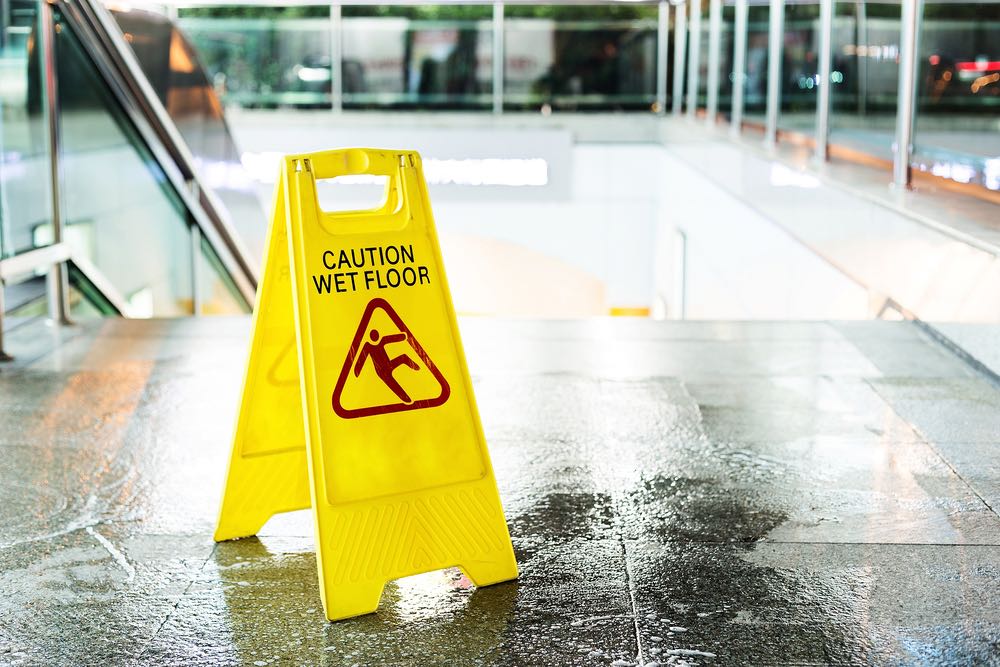
- Liquid on the Floor: A spill, leak, or recently mopped surface can create a serious slipping hazard in busy retail areas such as The Domain when the property owner fails to clean it up or provide an adequate warning.
- Broken Walkways: Cracked concrete, uneven pavement, or damaged flooring creates a tripping hazard.
- Poor Lighting: Broken or inadequate lighting makes stairs, elevation changes, or walkway hazards difficult to see.
- Unsafe Stairs: Loose handrails, broken steps, or uneven risers place visitors at risk.
- Unsecured Merchandise: Improperly stacked products or unstable displays can fall onto customers at busy shopping centers such as Barton Creek Square when store employees fail to secure them properly.
- Blocked Walkways: Boxes, cords, equipment, or debris create an unexpected obstruction.
Do Different Rules Apply to Businesses and Homes?
Businesses generally have a broader duty to look for dangerous conditions, while homeowners are usually responsible for hazards they already know about. The exact duty still depends on why you were on the property and whether Texas law treats you as an invitee or licensee.
Injuries on Commercial Property
Customers are usually invitees because they enter a business for a purpose that benefits the property owner. Commercial properties must use reasonable care to address dangerous conditions they know about or should discover through reasonable inspections.
Commercial claims may involve:
- Grocery stores and supermarkets
- Shopping centers and retail stores
- Restaurants and bars
- Hotels and apartment common areas
- Office buildings
- Parking lots and garages
Your Austin slip and fall lawyer can review inspection procedures, employee schedules, maintenance contracts, prior complaints, and surveillance footage to determine whether the business had notice of the danger.
Injuries on Residential Property
A social guest is usually treated as a licensee, which generally means the homeowner must warn about dangerous conditions that the homeowner actually knows about and that the guest is unlikely to discover.
Not every person on residential property has the same status. Tenants, contractors, delivery workers, and people entering shared apartment areas may be owed different duties depending on why they were there and who controlled the hazardous area.
Can a Dog Attack Lead to a Property Injury Claim in Texas?
A dog owner or property controller may be liable when a known dangerous animal, broken enclosure, or failure to use reasonable care leads to an attack. These cases are not automatically treated the same as ordinary slip-and-fall cases, so the legal theory must fit the facts.
A dog bite or knockdown may happen when:
- Known Aggressive Behavior: An owner knows the dog has acted aggressively before, but fails to warn a visitor.
- Broken Gate or Fence: A homeowner leaves a damaged enclosure unrepaired, allowing the dog to escape.
- Loose Dog in a Common Area: A landlord or property manager knows a dangerous dog is repeatedly roaming an apartment complex or shared space.
- Failure To Control the Dog: An owner does not restrain the dog during a delivery or an invited visit.
- Attack Beyond the Property: A dog escapes and attacks someone lawfully using a sidewalk or neighboring property.
Texas doesn’t impose automatic liability simply because a dog caused an injury. Depending on the facts, your Austin dog bite lawyer may need to prove that the owner knew about the animal’s dangerous tendencies or acted negligently by failing to restrain or control it.
How Lorenz & Lorenz, PLLC Preserves Evidence From the Property

Our in-house investigator helps our team document the hazard, locate witnesses, and seek records before the property owner changes the scene. That early work can make the difference between proving notice and facing a denial based on missing evidence.
When available, we may gather:
- Surveillance Footage: Video may show how the hazard developed, how long it remained, and whether employees walked past it.
- Incident Reports: A written report can confirm when and where the fall occurred and identify employees or witnesses.
- Inspection and Cleaning Logs: These records may show whether the business followed its own safety procedures.
- Witness Statements: Other visitors or workers may have noticed the hazard before the fall.
- Photographs of the Scene: Images can preserve the size, location, visibility, and condition of the hazard.
- Maintenance Records: Repair requests and prior complaints may show that the owner knew about a recurring defect.
- Medical Records: Treatment records help connect the fall to your injuries and document the care you required.
Your Austin dog bite lawyer can also send a preservation letter directing the property owner to retain relevant video, reports, and electronic records. A letter doesn’t guarantee that every piece of evidence still exists, which is why prompt investigation matters.
Seeking Compensation With an Austin Slip and Fall Lawyer
An Austin premises liability lawyer at Lorenz & Lorenz, PLLC can help you pursue compensation to cover your medical expenses, lost income, pain, and impairment caused by the fall.
Lorenz & Lorenz, PLLC has secured substantial recoveries in slip-and-fall cases, including $150,000 for a fall at a restaurant and $160,000 for a fall caused by spilled coffee creamer.
Compensation may include:
- Medical Expenses: You can seek reimbursement for the reasonable costs of emergency care, surgery, medication, follow-up visits, and rehabilitation.
- Future Medical Care: Serious injuries usually require additional procedures, therapy, mobility equipment, or long-term assistance.
- Lost Income: Your claim may include wages and other earnings you missed while recovering.
- Reduced Earning Capacity: If a lasting injury affects your ability to perform your prior job or earn the same income, your claim can pursue compensation for that loss.
- Pain and Suffering: This compensation accounts for the physical pain caused by the injury.
- Physical Impairment: You may recover damages when the injury limits your mobility, independence, or normal activities.
- Disfigurement: Permanent scarring or other visible changes often support additional damages.
A hard fall can cause hip fractures, broken wrists, spinal injuries, or traumatic brain injuries. Treatment at Dell Seton Medical Center and other local providers may be only the beginning if you later need surgery, rehabilitation, or ongoing care.
Our team carefully documents each category before starting negotiations with the insurer so that nothing, including future medical care, gets overlooked.
FAQ for an Austin Slip and Fall Lawyer
How Does an Austin Slip and Fall Lawyer Prove a Claim?
Your Austin premises liability attorney must prove that a dangerous condition caused your fall and that the property owner knew or should have known about it. The evidence must also show that the owner failed to correct the danger or provide an adequate warning.
Useful evidence may include photographs, surveillance footage, incident reports, witness statements, maintenance records, inspection logs, and medical documentation.
Is There a Filing Deadline for a Slip and Fall in Texas?
You generally have two years from the date of the accident to file a Texas slip and fall lawsuit. Missing that deadline may prevent you from recovering compensation, even when the property owner was clearly at fault. Claims involving government property may have much shorter notice requirements.
How Long Does a Texas Slip and Fall Case Take?
A Texas slip and fall case may take several months or longer than a year, depending on the injuries, available evidence, and whether the property owner disputes liability. A claim may resolve sooner when the fault is clear, and your medical condition is stable.
When Should I Call an Austin Slip and Fall Lawyer?
Contacting an Austin slip and fall lawyer after seeking medical attention gives you the best chance at preserving evidence before the property changes. Businesses may overwrite surveillance footage quickly, and witnesses become harder to find as time passes.
However, if some time has passed since your fall, a lawyer can look into other avenues of your claim to find the evidence you need.
Can I Recover Damages if I Were Partly Responsible for My Fall?
You may still recover compensation if you were 50% or less responsible for the accident. Texas reduces your recovery by your assigned percentage of fault, and the state bars recovery if you have more than 50% of the blame.
The property owner may claim that you were distracted, ignored a warning, or should have seen the hazard. We use the scene evidence and property records to challenge blame that is not supported by the facts.
Get the Legal Guidance You Need

A property owner trying to avoid responsibility doesn’t mean you have no case. Lorenz & Lorenz, PLLC can investigate how long the hazard existed, identify who controlled the property, and pursue compensation for the injuries and financial losses the fall caused.
Call us today at (512) 477-7333 or use our online form to get a free case review.